From Muazu Hardawa and Alhaji Modu Gashua, Damaturu
The North-East Muslim Ummah Forum has held a historic two-day stakeholders’ meeting in Damaturu, the Yobe State capital, bringing together representatives from all six states of the North-East zone, alongside delegates from other parts of the country.
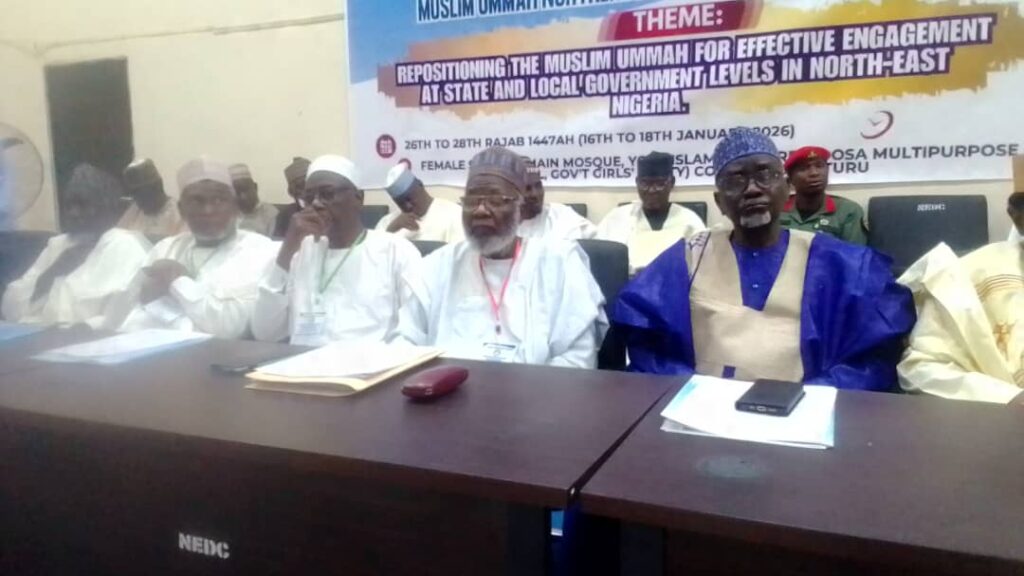
The maiden zonal meeting, held from 16 to 18 January 2026, attracted participants from Adamawa, Borno, Bauchi, Gombe, Taraba and Yobe states. The gathering provided a platform for extensive deliberations on contemporary national issues, with particular focus on the challenges confronting the Muslim Ummah and strategies for sustainable development and progress.
Discussions at the forum centred on social, moral, educational, leadership and developmental challenges facing Muslims and Islamic affairs in Nigeria. Participants examined practical approaches to strengthening unity, promoting moral values, enhancing leadership capacity and building resilience within Muslim communities across the region and the nation at large.
In his keynote address, the National President of the Muslim Ummah Forum, Professor Muhammad Babangida Gamawa of Bayero University, Kano, urged Muslims to develop clear focus and long-term vision aimed at improving living standards and achieving moral reforms. He emphasised that moral discipline and sound values are essential for building strong social immunity at all levels. Professor Gamawa also called on Muslims to mentor future generations on good character, responsible leadership and service to humanity.
Chairman of the occasion and former Minister, Governor and Senator from Kano State, Alhaji Ibrahim Shekarau, encouraged members of the Ummah to emulate the noble character of Prophet Muhammad (SAW). Quoting verses from the Holy Qur’an, he stressed the importance of self-reflection, renewed commitment to Islamic values and the adoption of policies that promote positive and sustainable outcomes for the Ummah.
The Yobe State Commissioner for Religious Affairs, Alhaji Yusuf Umar, urged Muslims, particularly the youth, to remain resilient and steadfast in the service of Islam and Muslim affairs. He commended the leadership of the Yobe State Muslim Ummah for their dedication and contributions to public service at various levels.
Also speaking, the Director-General of the Yobe International Islamic Centre, Dr Engr. Zaji Bunu, expressed appreciation to participants for their active engagement and charged members to redouble their efforts in serving Islam and the Muslim community. He underscored the importance of knowledge, integrity and honesty in the discharge of responsibilities. Dr Bunu also thanked the Forum for appointing him Chairman of the North-East Ummah Coordinating Committee and highlighted the interactive question-and-answer sessions that witnessed active participation by both men and women.
At the end of the deliberations, participants adopted comprehensive resolutions to serve as an operational roadmap for the Zonal Secretariat and state chapters for the 2026 administrative year. Key resolutions included the institutionalisation of an annual North-East Zonal Convention to promote unity, networking and periodic review of regional progress.
It was also resolved that zonal officers should meet quarterly to ensure effective coordination and monitoring of activities, while an annual retreat would be organised to evaluate performance, assess impact and measure achievements. At the state level, chapters were mandated to organise leadership training programmes and stakeholders’ meetings aimed at membership expansion, resource mobilisation and intensified advocacy to address community needs.
As part of its future growth strategy, the Forum resolved to prioritise youth engagement, particularly by integrating current and former members of the Muslim Students’ Society of Nigeria (MSSN), and to implement a deliberate succession plan that blends the wisdom of elders with the energy of youth. State chairmen presented reports on their achievements and challenges, while collectively proffering solutions to strengthen the Forum.
Participants also called for unity across all Islamic sects, emphasising shared values over divisive interpretations. Other resolutions focused on strengthening Muslim involvement in education, health and humanitarian services; addressing security and humanitarian challenges through lawful means; boosting investment strategies for financial sustainability; and engaging professionals and business leaders for technical and financial support. State chapters were further encouraged to adopt the “Zaria example” of mentorship and organisational continuity, while revitalising leadership structures at state and local government levels.
After the meeting, delegates paid a courtesy visit to the Emir of Damaturu, His Royal Highness Babashu Hashimi Ibn Umar Al-Amin El-Kanemi. The delegation explained the objectives of the meeting and expressed appreciation for the hospitality extended by the people of Damaturu. The Emir commended the Forum for choosing Damaturu as host city and prayed for divine guidance and the successful implementation of the resolutions for the benefit of the Muslim Ummah in the zone and Nigeria as a whole.
Yahoo Mail: Search, Organize, Conquer