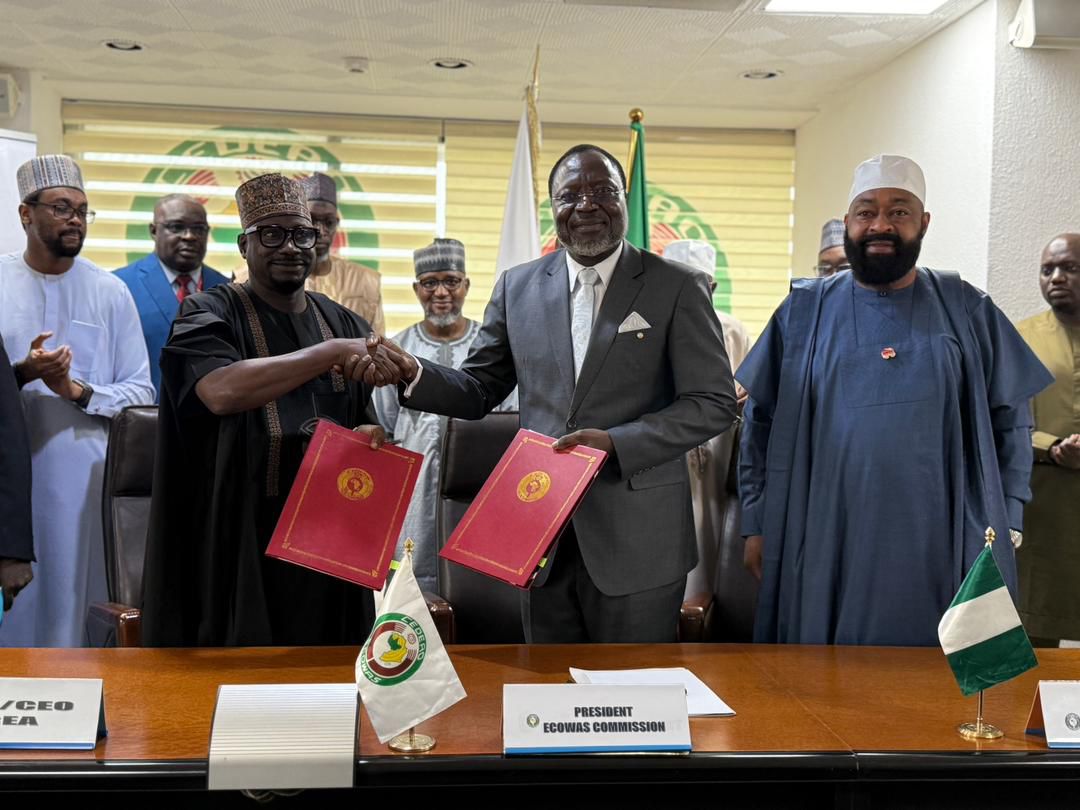
Rural Electrification Agency (REA) has signed a Memorandum of Understanding (MoU) with the Economic Community of West African States (ECOWAS) Commission to electrify 15 public health and education institutions across Nigeria with solar photovoltaic (PV) systems.
The agreement marks Nigeria’s pilot implementation under the Regional Off-Grid Electricity Access Project (ROGEAP), a World Bank-supported initiative aimed at expanding off-grid electricity access across West Africa and the Sahel.
Under the MoU, ECOWAS will provide a $700,000 grant to support the installation of solar PV systems in selected rural health centres and schools located in the Federal Capital Territory (FCT), Niger State, and Nasarawa State. REA will serve as the technical and financial implementing agency for the project.
Speaking at the signing ceremony, REA Managing Director and Chief Executive Officer, Dr. Abba Abubakar Aliyu, described the agreement as a strong demonstration of regional collaboration driving national development. He noted that electrifying health centres and schools would enhance healthcare delivery, improve learning conditions, and strengthen community development.
President of the ECOWAS Commission, Dr. Omar Alieu Touray, described the Nigeria pilot phase as a cornerstone of the regional strategy to eliminate energy poverty. He emphasized that sustainable solar solutions for public institutions would help power long-term socio-economic growth across West Africa.
To ensure effective implementation, REA will establish a dedicated Project Implementation Unit (PIU) to work closely with the ROGEAP team and a Steering Committee overseeing the initiative.
In alignment with the ECOWAS agreement, REA also signed a separate MoU with the Niger State Government to enable state-level coordination and counterpart support for selected project sites. The state government will collaborate on co-financing, coordination, and monitoring of installations.
Governor of Niger State, Hon. Mohammed Umar Bago, reaffirmed his administration’s commitment to sustainable infrastructure under the “New Niger” agenda, pledging the state’s support to ensure successful project delivery.
The initiative is expected to improve energy reliability in rural public facilities, reduce reliance on diesel generators, lower operating costs, and promote clean energy adoption in line with Nigeria’s national energy transition
Yahoo Mail: Search, Organize, Conquer