The National Coordinator of the Presidential Initiative for Unlocking the Healthcare Value Chain (PVAC), Dr. Abdu Mukhtar, has disclosed that Nigeria imports about 99 per cent of its medical devices, 70 per cent of essential medicines, and 100 per cent of its vaccines, a situation he described as unsustainable for a country with growing healthcare needs.
Mukhtar made this revelation in Lagos on Tuesday while delivering the keynote address at the Scientific Products Association of Nigeria (SPAN) Conference and Exhibition, themed “Science, Laboratory and Sustainable National Development.”
He noted that the heavy dependence on imports in Nigeria’s healthcare value chain undermines national resilience and calls for urgent domestic investment in medical research, manufacturing, and innovation.
“We import 70 per cent of our essential medicines and almost all our vaccines,” he said. “This over-reliance on foreign products not only puts pressure on foreign exchange reserves but also exposes the country to vulnerabilities in global supply chains. We must begin to prioritise local production, innovation, and collaboration across science, technology, and health sectors.”
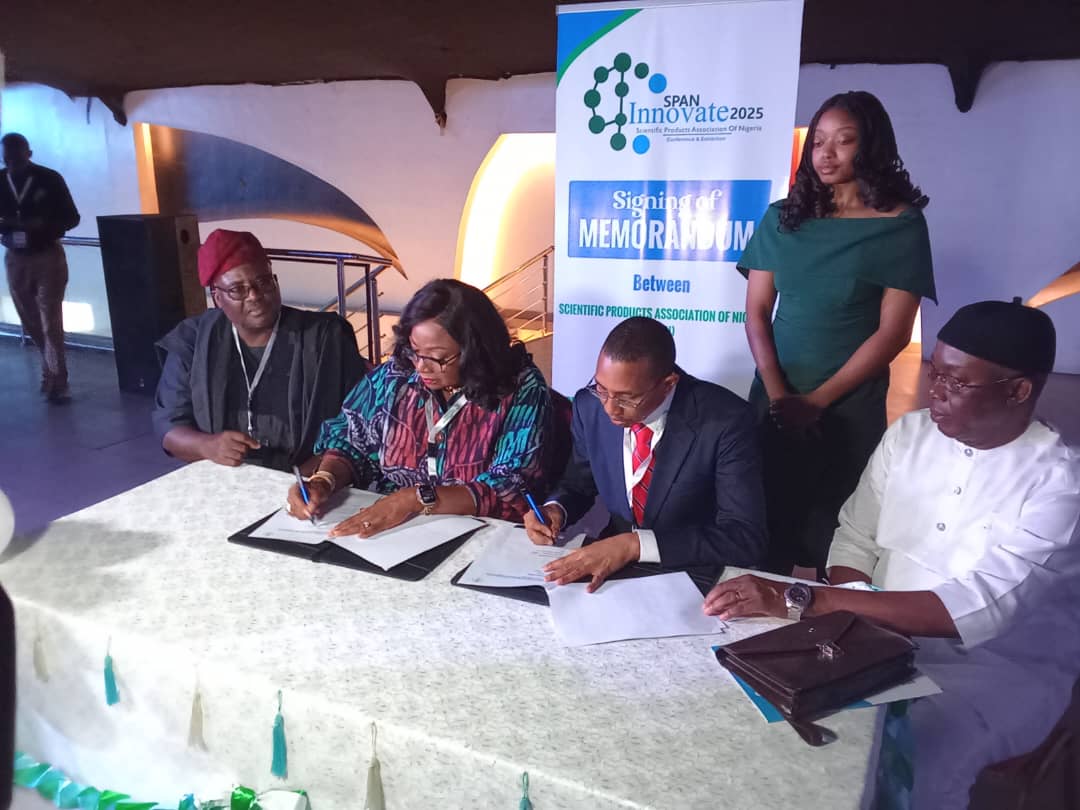
The disclosure came as SPAN and PVAC signed a Memorandum of Understanding (MoU) to drive innovation, research, and vocational education across the country. The signing, witnessed by Finlab Chairman, Chief Uzomba Nwaije, took place during the SPAN Innovate 2025 Conference, which convened experts from science, technology, and creative industries to explore new paths for national transformation.
In her remarks, Dr. (Mrs.) Kate Isa, President of SPAN, stressed the need for Nigeria to develop home-grown scientific solutions that address the realities of its people. She said medical solutions developed by Western researchers often fail to serve Africans effectively because their genetic diversity is underrepresented in global research data.
“Indeed, the world is moving rapidly towards precision science and personalised medicine,” Isa noted. “Faced with evidence that the genes of black Africans are not significantly represented in research, we must wake up and begin to find our own solutions. We have hardworking, resilient, and intelligent Nigerians. With Artificial Intelligence and modern scientific tools, we can catch up if we all set our minds to it.”
Representing the Lagos State Environmental Protection Agency (LASEPA), Chief Kayode Bello, on behalf of Dr. Babatunde Ajayi, showcased the state’s transition from analogue to digital environmental monitoring, allowing remote assessment of air quality and noise pollution.
“Our lab is second to none in Africa,” Bello said, adding that this digital transformation supports the conference’s goal of leveraging science and technology for sustainable national development.
Also speaking, the Senior Special Assistant to the Lagos State Governor on Basic and Secondary Education, Opeyemi Eniola, highlighted the state’s investments in youth-led research and innovation.
“Students from public schools are conducting meaningful research. Some have even developed devices that earned them international travel opportunities — all funded by the state government,” he stated.
Eniola commended Governor Babajide Sanwo-Olu’s efforts toward building a “smart city” through science-driven governance. “We are not just building infrastructure; we are building minds,” he added.
The SPAN Innovate 2025 Conference concluded with a renewed commitment to strengthen partnerships between SPAN and PVAC aimed at enhancing Nigeria’s healthcare innovation capacity, boosting local production, and promoting scientific and creative collaboration for national development