By Victoria Tokolo
The Association of Professional Women Engineers of Nigeria (APWEN) has renewed calls for greater investment in women-led sustainable enterprises as part of efforts to combat waste pollution and drive economic growth across Nigeria and Africa.
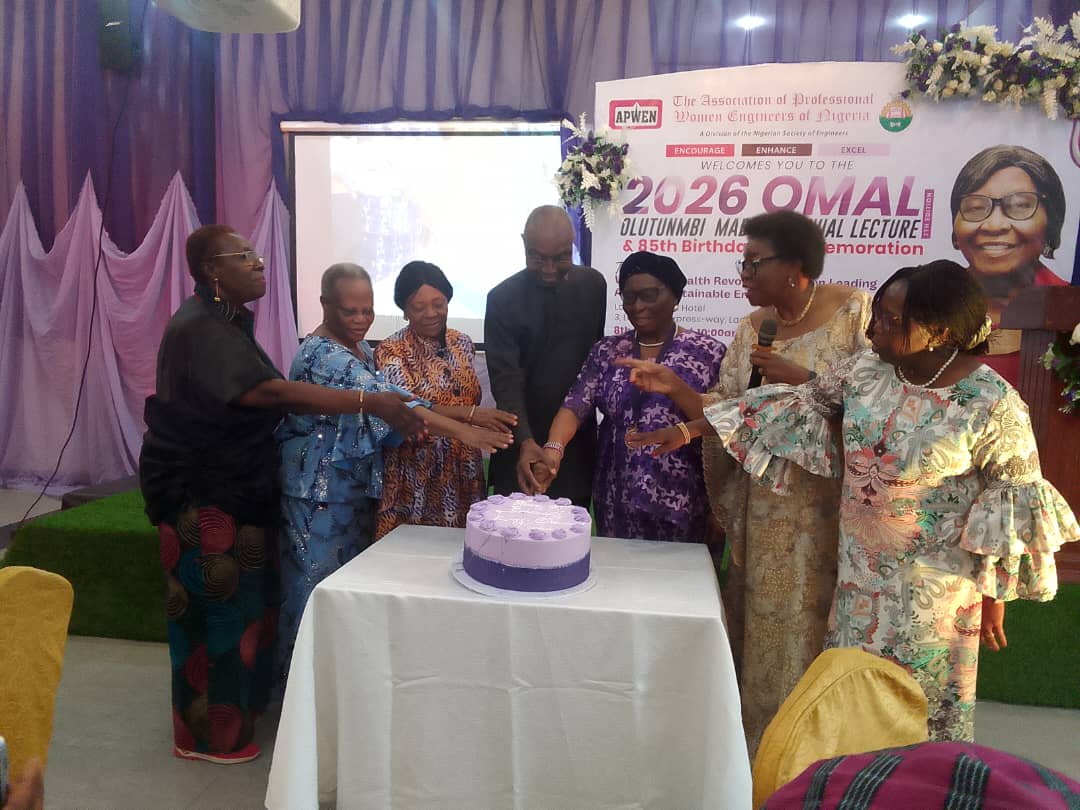
The appeal was made on Friday during the 2026 Olutunmbi Joanna Maduka Annual Lecture and the 85th birthday celebration of APWEN founder, Olutunmbi Joanna Maduka. The event, themed “Waste to Wealth Revolution: Women Leading Africa’s Sustainable Enterprises,” brought together engineers, academics, innovators and stakeholders from across the country.
Speaking at the event, Maduka stressed that waste can only become wealth through innovation, engineering, manufacturing and market development. She noted that Africa faces growing environmental challenges ranging from plastic pollution and agricultural residue to textile waste and invasive species, but said women-led enterprises are already transforming these problems into economic opportunities.
According to her, women across Africa are converting waste streams into community-based businesses that combine environmental sustainability with job creation and local development.
“Women leading the waste-to-opportunity revolution are not simply recycling waste; they are redesigning value and rebuilding local economies,” she said.
Maduka added that Africa’s future circular economy would rely heavily on the integration of artificial intelligence, engineering, digital systems, material science and craftsmanship. However, she warned that many local enterprises may struggle to compete globally without technological advancement and improved production systems.
She also encouraged young girls to pursue careers in engineering by taking science and mathematics seriously from an early age.
“The main issue is that girls must be serious about subjects that lead to engineering, especially mathematics and science,” she said.
Maduka further urged governments and private organisations to support innovations capable of converting waste generated in homes and industries into useful products.
In her remarks, APWEN President, Chinyere Nnenna Igwegbe, described the occasion as a celebration of legacy, innovation and women’s leadership in engineering. She praised Maduka for creating opportunities for female engineers at a time when women were scarcely represented in the profession.
“You did not just start APWEN; you birthed a movement,” she said.
Igwegbe highlighted several innovations driven by women engineers across Africa, including the conversion of discarded bottles into building materials, cassava peels into bioplastics and landfill gas into electricity.
“This revolution is not just about cleaning up the environment; it is about women taking the lead in circular economies, green manufacturing and sustainable enterprise,” she added.
Also speaking, Deputy President of the Nigerian Society of Engineers, Valerie Ageragba, called for collective responsibility in environmental sustainability, noting that preserving the environment should remain a priority beyond wealth creation.
General Manager of the Nigerian Academy of Engineering, Temitayo Okunoren-Makindipe, described the lecture as inspiring for women aspiring to leadership in engineering and innovation. She urged both government and the private sector to increase funding support for research and engineering projects.
“If we can harness even a fraction of final-year engineering projects in Nigeria over the next decade, imagine the level of growth and development we could achieve as a nation,” she said.
Director of Programmes, Mosupe Adewoyi, called for stronger public awareness campaigns on proper waste disposal, while Chairman of the OMAL 2026 Planning Committee, Rose Madaki, encouraged young entrepreneurs to take advantage of government loans and mentorship opportunities.
Also speaking at the event, Mr. Maduka, husband of the APWEN founder, said materials often considered waste could still be transformed into valuable products.
“Nothing is truly wasted. What is needed is the skill to turn it into something useful and desirable,” he said.
The annual lecture ended with participants advocating stronger collaboration among government, professional bodies, academia and private organisations to promote women-driven solutions in environmental sustainability and waste management across Africa